Anyone who has heard or tried to learn Serbian has noticed that it is complex in grammar, difficult to pronounce, and often so rich in variation that even native speakers sometimes wonder whether they said everything correctly. However, pronunciation and structure become much clearer once we acknowledge the fact that the Serbian language did not appear overnight; it was not “invented” by someone, nor did it emerge in a single year. It is the result of a long, living process that has lasted for more than a thousand years.
Stay with us until the end of the text and find out how the Serbian language was formed, a language full of life and emotion, a language that can challenge even the most skilled polyglots until they get used to it, and then inevitably becomes a favorite language.
The Origin of the Serbian Language
The Serbian language originates from the Proto-Indo-European language. Before the Serbian language existed, there was the Proto-Slavic language.
It was the common language of all Slavs, people who lived across a vast area of Eastern and Central Europe. There was no Serbian, Croatian, Russian, or Polish; everyone spoke variations of the same language.
Around the 5th and 7th centuries, the Slavs began to migrate. During these migrations, they divided into three groups (South, East, and West Slavs). The Serbian language belongs to the South Slavic group, alongside Croatian, Macedonian, Bosnian, Slovenian, and Bulgarian.
After the Slavs settled in new territories, the language began to develop, and after the adoption of Christianity and the abandonment of paganism, Old Church Slavonic emerged.
Since they did not have their own script for writing and speech, and faith is more difficult to understand if the service is held in a language the people do not understand, a major change occurred in the 9th century.

Further Development of the Serbian Language and the Creation of the Script
In the ninth century, in the territory of the present-day Czech Republic, a principality was ruled by Prince Rastislav. He was aware that people could not learn or accept religion in Latin because they did not understand it, and he asked the Byzantine emperor to send educated men who would spread Christianity among the people in their own Slavic language. The Byzantine emperor then sent two learned monks, brothers from Thessaloniki, Cyril and Methodius, who arrived in these regions in 863, and this is why this year is considered the beginning of Slavic literacy.
Following the Greek script, they created the Slavic Glagolitic alphabet, which featured many angular and unusual characters.
They brought Christianity much closer to the people, gained their trust, and many students joined them who, after their deaths, continued their work and made equally significant contributions to the Slavic people.
The Serbian Language and the Creation of Cyrillic as the Primary Script
After Cyril and Methodius passed away, their students continued their work in the territory of present-day Bulgaria, attempting to simplify the Glagolitic script and transform it into a simpler system of letters. At that time, at the end of the 9th and the beginning of the 10th century, the Cyrillic alphabet was created, named after Cyril.
By the 12th century, Cyrillic had completely replaced Glagolitic and had become the primary script still used in Serbian today.
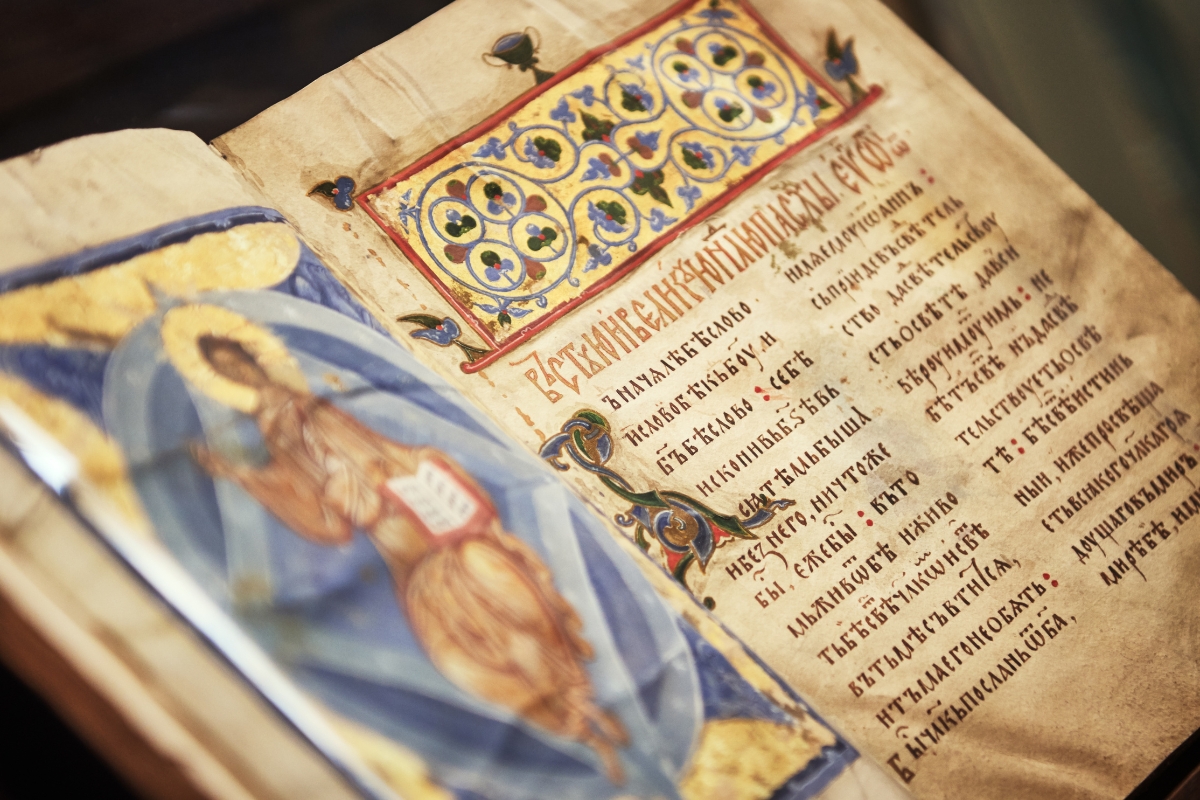
The Serbian Language After the Formation of the Cyrillic Script
From the 12th to the 19th century, books were written in Serbian, and new literary works began to emerge, though somewhat later. At first, when Cyrillic was developed, only church books were translated so that people could read sermons and become educated in religion and Christianity.
During this period, Church Slavonic and Serbian Slavonic were in use, and Serbian was still not fully developed.
Only with the appearance of remarkable individuals such as Dositej Obradović and Vuk Karadžić did the Serbian language strengthen, gain a unified form, and begin to be used for creating literary works, not just for translating church books.
The Serbian Language and the Reformer Vuk Karadžić
The period that followed was one of gradual development until the 19th century, when one man, Vuk Karadžić, introduced major reforms in the language.
He:
• simplified the alphabet
• removed complicated rules
• introduced the народni speech into literature
This is how the foundation of the modern Serbian language was created.
For foreigners, this is a huge advantage, believe it or not, and we should thank Vuk for the fact that Serbian is today one of the most phonetically consistent languages in the world.
His idea, “Write as you speak,” reduced Serbian to a simple system in which each sound corresponds to a single letter.
Although simple in that sense, the Serbian language is still rich in grammatical complexities, but at least we do not have to worry about inconsistencies in writing and pronunciation.
Understanding how a language developed helps us learn it more easily.
Because we see that:
• Serbian is not “difficult” — it is logical
• rules are not random — they are the result of development
• Many words have roots that repeat across Slavic languages
The Serbian Language Today
Today, changes in the Serbian language occur quickly, and many words from other languages are adopted into Serbian at a rapid pace. Dozens of new words appear every month, and the language expands through colloquial expressions and slang used by younger generations.
Despite these changes, the Serbian language retains its core principles, that one sound corresponds to one letter, and that certain grammatical rules remain stable and do not change.
When learning Serbian, be persistent and speak with native speakers; you will see that this seemingly complex language is truly beautiful and that it opens many possibilities for you to adapt it to yourself and express your emotions in the right way.

