Learning Serbian can be quite a challenge for many foreigners, and one of the most common difficulties is prepositions. The tricky part is that they are not fixed, but instead change depending on the case. At first glance, they may seem simple, but in practice, they often cause confusion because each preposition requires a specific case. When combined with a noun or pronoun, they form prepositional phrases.
Stay with us until the end of this guide to learn how you can quickly and easily master Serbian prepositions.
What Are Prepositions?
Prepositions are invariable words that connect other words in a sentence and express relationships of place, time, cause, manner, and more. Examples include: u (in), na (on/at), sa (with), kod (at), zbog (because of), prema (towards). They can never stand alone in a sentence but are always linked to a specific case.
Here are a few examples with prepositions:
- Idem u školu. (I am going to school.)
- Knjiga je na stolu. (The book is on the table.)
- Razgovaram sa prijateljem. (I am talking with a friend.)
- Uzeću to od tebe. (I will take it from you.)
In each example, the preposition requires a specific case: u školu (accusative), na stolu (locative), sa prijateljem (instrumental).
Why Are Prepositions Difficult for Foreigners?
- Different cases – A single preposition can require different cases depending on the meaning (na stolu – locative, na sto – accusative).
- Differences compared to English or other languages – For example, the English preposition in can be translated as both u and na in Serbian, depending on context.
- Frequent use in everyday speech – It is nearly impossible to form a natural sentence in Serbian without prepositions, because otherwise the meaning would be unclear.
Consider the difference between Uradićemo do petka (We will do it by Friday) and Uradićemo od petka (We will do it starting from Friday).
Prepositional Phrases in Serbian
Prepositional phrases are formed when a preposition is combined with a noun, adjective, or pronoun in the appropriate case. They provide additional information and enrich the sentence.
Examples:
- u Beogradu (in Belgrade)
- na poslu (at work)
- kod kuće (at home)
- sa prijateljima (with friends)
These expressions are essential for understanding and speaking Serbian naturally. One important thing to know is that a single preposition may be used with different cases, and this can significantly change the meaning of the sentence.
Here is how prepositions correspond to cases:
- Nominative – never used with a preposition.
- Genitive – answers the question “from where”: iz (from), sa (from), od (from), do (to/until), pored (beside), kod (at), blizu (near), ispod (under), iznad (above), iza (behind), između (between), oko (around), van (outside), zbog (because of), uprkos (despite).
- Dative – ka (towards), prema (towards), uprkos (despite).
- Accusative – expresses direction or goal: na (onto), u (into), po (across/around), uz (up), niz (down), kroz (through), za (for), pod (under), pred (in front of), među (among).
- Instrumental – answers “with whom/with what”: sa (with), nad (above), pod (under), pred (in front of), među (among).
- Locative – expresses place: na (on/at), u (in), o (about), po (on/through), prema (towards), pri (at/by).
How to Learn Prepositions More Easily
- Learn prepositions together with cases – Never study a preposition in isolation. Always connect it with the form it requires (u školi, na poslu, sa prijateljem).
- Use examples from everyday life – Create a list of phrases you actually use (for example: u prodavnici – in the store, na aerodromu – at the airport, kod doktora – at the doctor’s).
- Compare with your own language – Look for similarities and differences (English at home = Serbian kod kuće).
- Practice through questions and answers –
- Gde si? – U školi. (Where are you? – At school.)
- Kuda ideš? – U školu. (Where are you going? – To school.)
- S kim ideš? – Sa drugaricom. (Who are you going with? – With a friend.)
- Listen and read in Serbian – The more often you hear prepositions in context, the more natural they will become.
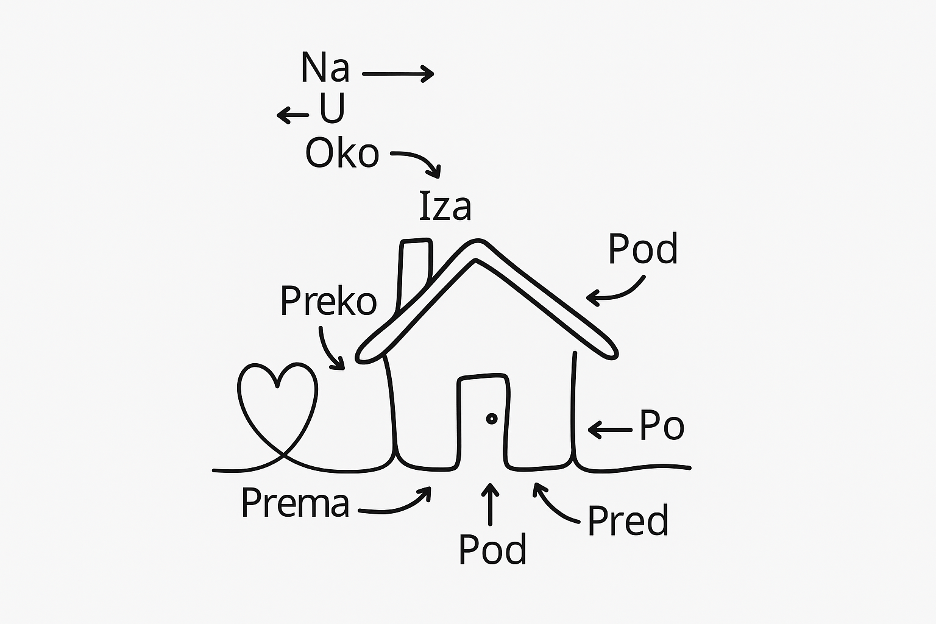
If you are a visual learner rather than an auditory one, here is a helpful trick that will help you never confuse what is or isn’t a preposition. Imagine a house. Everything you can add to describe the house is a preposition. For example:
- u kući (in the house)
- na kući (on the house)
- oko kuće (around the house)
- ispod kuće (under the house)
- iznad kuće (above the house)
- preko kuće (over the house)
- iza kuće (behind the house)
This way, you will remember that prepositions can never stand alone because they always need their “house.”
Conclusion
Serbian prepositions are not as frightening as they may seem. The key is to always learn them in context and together with cases. Once you master the basic prepositional phrases and use the “house” visualization, it will be much easier to build sentences and speak naturally.
Here is a simple exercise: cross out the words from the house that are not prepositions. Read each preposition and connect it to the phrase kuća (house). This way, you practice both prepositions and cases at the same time.
- Od (kuća)
- Iz (kuća)
- Na (kuća)
- Pored (kuća)
- Sedim (kuća)
- Prema (kuća)
- U (kuća)
- O (kuća)
- Reči (kuća)

