When learning a foreign language, the focus is usually on grammar, vocabulary, and correct pronunciation, and we tend to concentrate on mastering those first. However, what makes speech sound natural are often small, seemingly insignificant words that fill pauses, connect ideas, and give rhythm to conversation. In linguistics, these words are referred to as filler words and discourse markers.
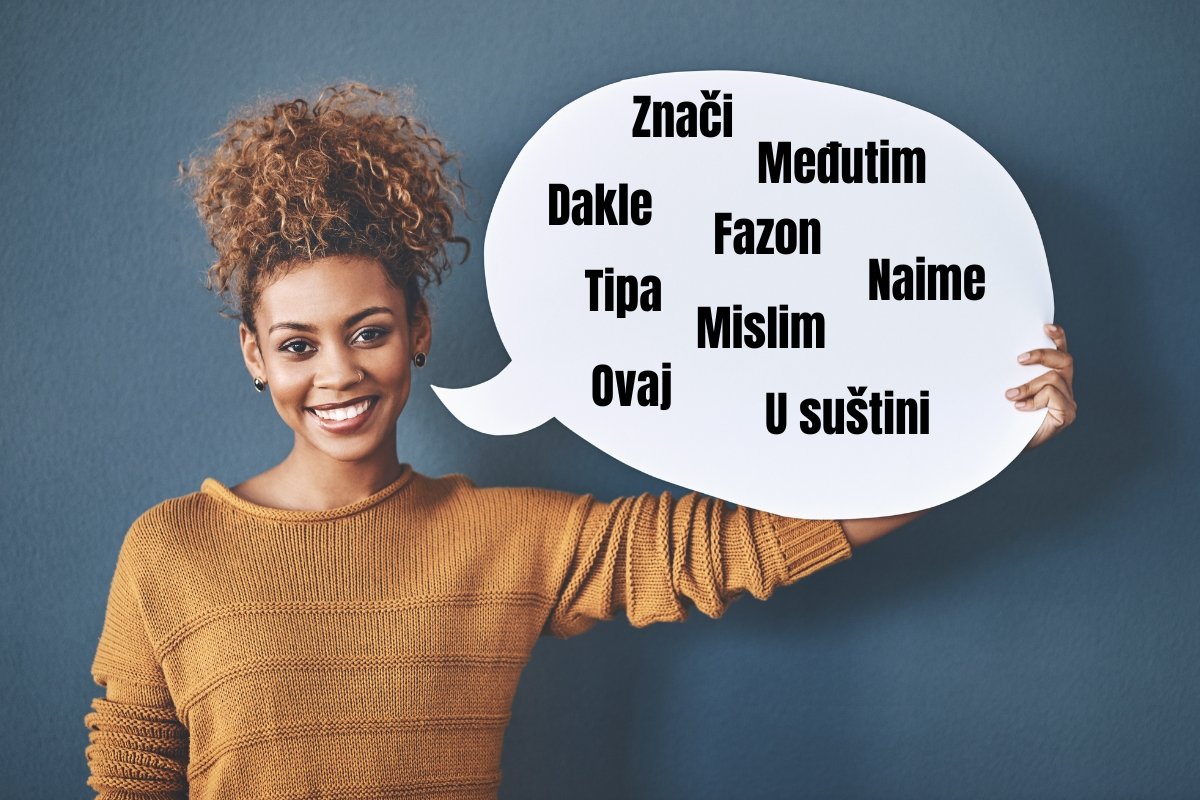
In Serbian, they are especially present and play an important role in everyday communication, from spontaneous conversation to more formal expression. Through them, you can learn a lot about the language but also about Serbian speakers themselves, so stay with us until the end of the article to discover the most common Serbian filler words and discourse markers.
What are filler words?
Filler words are words or sounds we use when thinking about what to say next or when we want to soften an utterance. They do not necessarily carry new meaning, but they have an important function in the flow of speech.
Examples:
- ovaj / ovaaaaj
• pa
• ono
• mislim
• znači (when used as a pause)
Their role is similar to English words such as um, uh, or like. They help the speaker maintain the flow of conversation and signal that the sentence is not yet finished.
They are most often short and serve as a kind of linguistic bridge, giving us space to think about the continuation of a sentence and connect parts of our thoughts.
What are discourse markers?
Discourse markers are a broader concept. These are words and expressions that organize speech, connect ideas, and guide the listener through the message. Most often, they are particles — invariable word forms that help structure a sentence so it flows naturally without sounding like a news broadcast.
In Serbian, these may include:
- Dakle
- Međutim
- Zapravo
- U suštini
- S druge strane
- Naime
- Generalno
Unlike classic filler words, these expressions often carry a rhetorical function — they highlight conclusions, contrast, explanation, or stance.
Another important difference between discourse markers and filler words is that discourse markers are characteristic of academic speech, lectures, and higher-level explanations, whereas filler words are closer to slang and everyday conversation.
Why are filler words and discourse markers so widely used in Serbian?
Serbian speech is rhythmic and flexible, with a relatively free word order. Because of this, speakers often use small words as a “bridge” between thoughts.
The Serbian language is rich in emotion, often full of irony, metaphor, and layered meanings, which is why it is abundant in filler words — they act as ornaments that guide how a speaker’s thought will unfold. For example, a speaker may be presenting a completely logical chain of thought, and the moment they say the word međutim (“however”), you know a complete shift is coming. These sentence constructions are particularly enjoyed by Serbian speakers, which is why discourse markers are so widely used.
Frequent turns, unexpected conclusions, and new meanings emerging mid-thought characterize Serbian, and this is precisely why it is so rich in discourse markers and filler words.
They can buy time while an idea is being formed, soften directness, emphasize a stance and make speech sound more natural and warm.
Because of this function, the boundary between filler words and discourse markers is often not strict. In Serbian, filler words are used even in academic presentations, so we can say that discourse markers form the larger set, while filler words represent a subset of linguistic helpers within a sentence.
“Znači” as a distinct linguistic phenomenon in Serbian
One of the most interesting words in contemporary Serbian speech is znači. Although it literally means ‘meaning’ or ‘conclusion,’ in practice it has a much broader use.
It can function as:
- a pause while the speaker thinks
- an introduction to an explanation
- emphasis
- a sign of frustration or insistence
In that sense, znači is simultaneously a filler word and a discourse marker, making it particularly interesting to linguists and to foreigners learning the language.
We will discuss this fascinating word in future blog posts, as it truly deserves a broader explanation.
Slang variants of filler words in Serbian
Contemporary speech, especially among younger generations — from Gen Z to Gen Alpha — introduces new discourse markers and filler words:
- fazon
- tipa
- bukvalno
- realno
- u fazonu
- buraz
- brate
These words often serve to create closeness with the interlocutor and signal informality. They can be heard among younger speakers who can hardly imagine a sentence without them and who sometimes face difficulty when speaking formally, as filler words have become so internalized that they occasionally slip into formal conversations.
Should foreigners learn Serbian filler words and discourse markers?
Although they rarely appear in textbooks, filler words and discourse markers are essential for understanding natural speech. Recognizing them helps learners follow conversations more easily, understand nuance, and sound more relaxed when speaking.
However, it is important to use them in moderation, as excessive use may create the impression of uncertainty or disorganized speech.
Listen carefully when Serbian speakers talk, and you will notice a clear difference between filler words and discourse markers. Compare formal speech — such as an academic lecture or a professor’s presentation — with friends talking on the street. You will hear contrasting styles:
Formal: I tried to finish the project; however, it did not proceed as planned.
Informal: I tried to finish the project and, like, everything basically fell apart.
Formal: I believe that this is, in fact, a very good idea.
Informal: Honestly, that idea is literally great.
Formal: I planned to go; however, I changed my mind when I saw it was raining.
Informal: I planned to go, but realistically, I couldn’t because of the rain.
Filler words and discourse markers show how language functions beyond rules and textbooks. They reveal the rhythm of thinking, social relationships, and communication style.
For that reason, these small words play a major role in shaping how Serbian sounds, natural, flexible, and conversational.

