To foreigners meeting Serbs for the first time, it’s often striking how similar and melodious their surnames sound. That’s because most Serbian last names end in the suffix “-ić” or “-vić,” which gives full names a rhythmic, flowing quality that many find pleasant to hear.
In this article, we’ll explain why Serbian surnames often end in -ić, what this suffix means, and how these names are correctly pronounced.
What Does “-vić” Mean in Serbian?
The ending “-vić” is a variation of the suffix “-ić” with the consonant v added for phonetic reasons—usually when the root name ends in a vowel. While “-ić” on its own means “little” or “son of,” the extended form “-vić” serves the same purpose but fits better with specific names.
Why Do Serbian Surnames End in “-ić”?
Serbian surnames typically end in -ić because they originated from patronymics (derived from the father’s name) or, less commonly, matronymics (from the mother’s name). In Serbian culture, as in other Slavic traditions, surnames evolved as a means of identifying individuals more precisely within a community.
For centuries, Serbs lived in tight-knit communities on shared territory. As these communities expanded and people began moving away, forming new households, and settling elsewhere, there was a need to distinguish one family from another. This led to the custom of identifying someone as “the son of so-and-so,” which gradually evolved into a permanent family name.
From the 15th century onward, the desire to differentiate one family from another became increasingly pronounced—especially within larger collectives, such as villages, tribes, clans, or extended family cooperatives. By the 19th century, as Serbia modernized (during the era of the Principality of Serbia), the state required families to use fixed surnames for tax records, military service, and civil registries. At that point, patronymic identifiers, already in wide use, became official surnames.
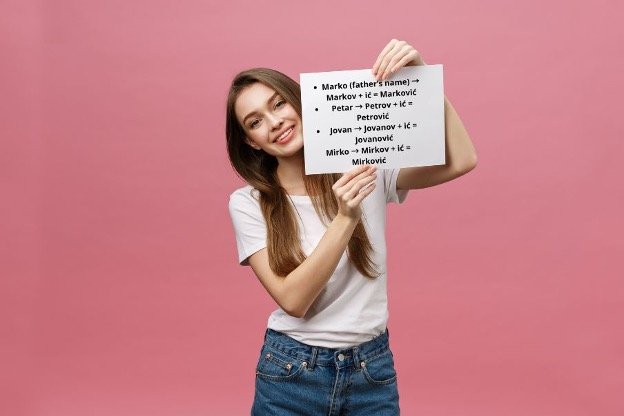
These names were usually formed by creating a possessive adjective from the father’s name, followed by the suffix -ić. For example:
- Marko (father’s name) → Markov + ić = Marković
- Petar → Petrov + ić = Petrović
- Jovan → Jovanov + ić = Jovanović
- Mirko → Mirkov + ić = Mirković
Because of the complexity of Serbian phonetics and grammar, not all surnames followed this exact formula. In some cases, the v was dropped, while in others, the name changed form due to sound shifts and other linguistic rules.
Do All Serbian Last Names End in “-ić”?
No, not all Serbian surnames end in -ić, although the vast majority do. Some surnames originated from other sources—especially when the goal was to preserve a father’s or son’s identity in a distinctive way or when a family was known for a specific characteristic.
Examples include:
- Surnames based on geographic origin (e.g., Bosanac, Sremac)
- Surnames based on occupations (e.g., Kovač [blacksmith], Pop [priest], Mesar [butcher])
- Surnames based on personal traits or nicknames (e.g., Crni [black], Veliki [big], Mali [small])
Still, in modern Serbia, surnames ending in -ić remain the dominant pattern, making this feature one of the most recognizable aspects of Serbian culture and language.
How to Pronounce Serbian Last Names
For those unfamiliar with the Balkan region, pronouncing Serbian surnames can be a challenge. Serbian is a phonetic language, which means every letter is pronounced as it’s written.
However, some sounds don’t exist in many other languages, making them harder to pronounce.
Here are a few key pronunciation tips:
- Ć is a soft “ch” sound, like the “cc” in cappuccino
- Č is a hard “ch,” like in chocolate
- Đ is similar to the English “j” in juice
- Š is like “sh” in shoe
- Ž sounds like the “s” in measure or the French “Jacques.”
Example pronunciations:
- Petrović – Pe-tro-vich (not Pet-ro-vik)
- Jovanović – Yo-va-no-vich
- Milošević – Mee-lo-she-vich
It’s also worth noting that while Serbian stress is dynamic and can shift, surnames usually place the emphasis on the second-to-last syllable, which gives them a distinct rhythm and tone.
Conclusion
The Serbian custom of forming surnames based on the father’s name—or another distinguishing trait—reflects a broader cultural transition from a collective to an individual identity, a tradition of oral heritage, and a practical need to differentiate people in growing and increasingly complex communities.
Adding -ić preserved a sense of shared identity while also establishing family lineage. It served as a natural way to:
- Express ancestry
- Move away from old collective identities (tribes, clans)
- Create a distinct line of descendants
- Retain a sense of Serbian unity
Serbia is a fascinating country, rich in history and language. Suppose you’re interested in learning more about the beauty of the Serbian language, and you enjoy a challenge. In that case, we invite you to join our online Serbian lessons for foreigners at Serbology.


One thought on “Why Do Serbian Last Names End in “-ić”?”
Very interesting and well explained, thank you